After months of suspense, President Dilma Rousseff’s impeachment looks set to proceed in a floor vote in the Chamber of Deputies on Sunday, April 17. At present, impeachment seems more likely than not: Vice President Michel Temer and his allies have overcome many of the political hurdles to impeachment by skillfully creating a bandwagon effect among legislators, in part by arguing that there is little point in continued support for the outgoing Rousseff and that now is the time to make sweet deals with the incoming Temer administration. This week’s desertions mean that of the seven largest parties in Congress, only one (the PT) still supports the president, while five are in opposition (PMDB, PSDB, PP, PSB, and DEM) and one is still officially undecided (PR).
Like a long night of heavy drinking, Sunday’s impeachment vote may feel at the time like a fitting way to put an end to the Rousseff years of economic mismanagement and political turmoil. Many Brazilians may be out demonstrating on Sunday, and celebrating (or drowning their sorrows) late into the evening. But Monday morning will bring a massive hangover, and like the aftermath of many a hard night, the morning after will bring as many new puzzles as it resolves:
The Senate: The immediate question is whether the Senate will break the momentum set in motion in the Chamber of Deputies. Senate President Renan Calheiros has pledged support to Rousseff, but simultaneously assured the pro-impeachment forces that he will not get in the way of a Senate trial. Can the hapless Rousseff administration successfully build a more effective defense in the Senate, working with allies like this? They will have little time to mount a defense, as the Senate could vote within fifteen days on whether or not to proceed to trial. If a simple majority agree to proceed, Rousseff would be suspended from office for 180 days, handing her presidential powers of appointment and budgetary allocation over to Temer. Once that happens, it is hard to see how Rousseff holds together her evanescent coalition or builds up a new base of support, no matter how strong her defense in the Senate trial.
John J. Mearsheimer: The Return of Great-Power Politics
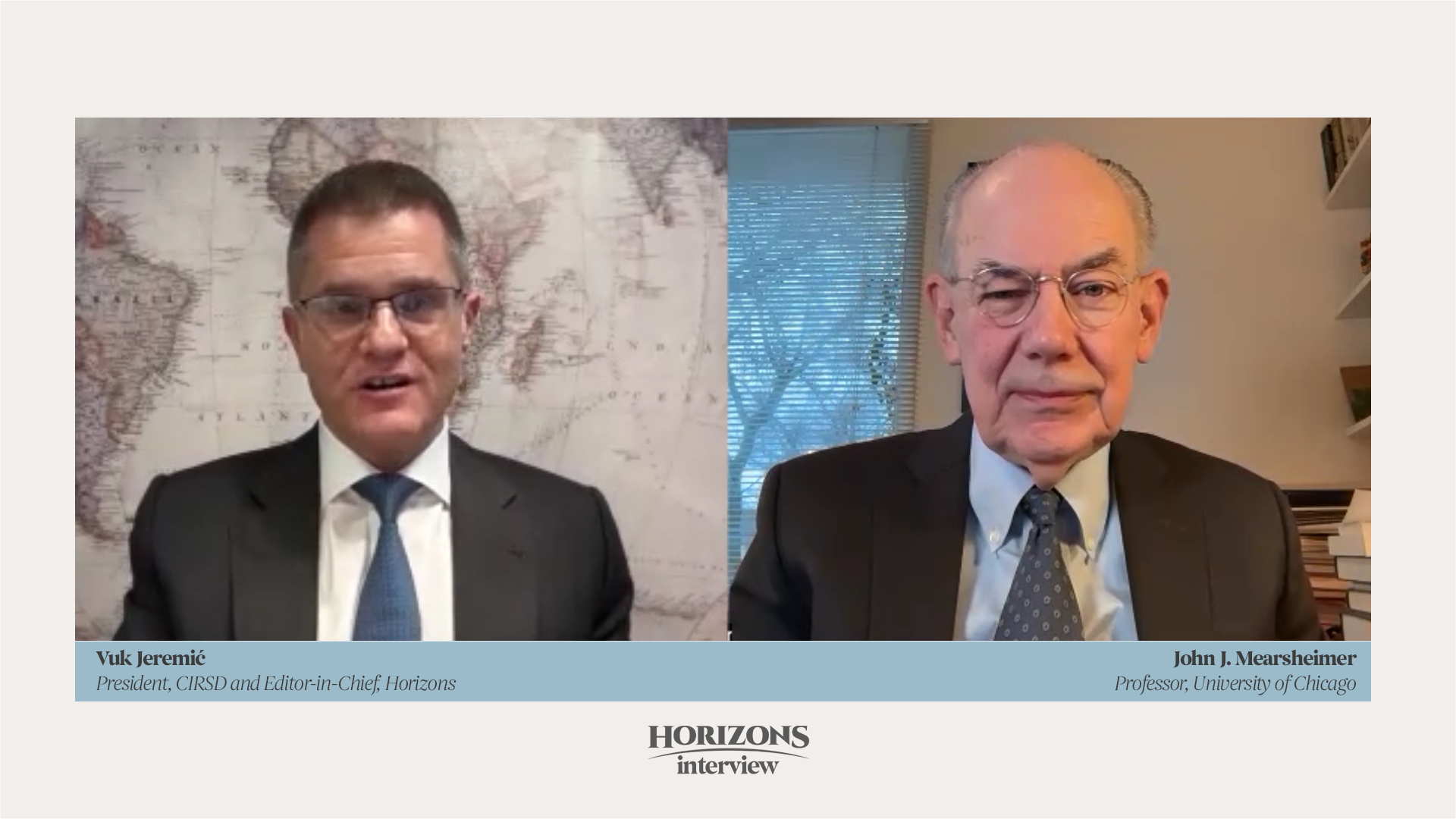
The Center for International Relations and Sustainable Development (CIRSD) has published a new Horizons Interviewwith Professor John J. Mearsheimer, one of the most influential political scientists of our time and the leading voice of structural realism in international relations. The interview was moderated by Vuk Jeremić, President of CIRSD and Editor-in-Chief of Horizons.
Read more
Economic Statecraft’s Impact on Geopolitical Realities
European Russophobia and Europe’s Rejection of Peace: A Two-Century Failure
Europe has repeatedly rejected peace with Russia at moments when a negotiated settlement was available, and those rejections have proven profoundly self-defeating.
Read more

 Author:
 After months of suspense, President Dilma Rousseff’s impeachment looks set to proceed in a floor vote in the Chamber of Deputies on Sunday, April 17. At present, impeachment seems more likely than not: Vice President Michel Temer and his allies have overcome many of the political hurdles to impeachment by skillfully creating a bandwagon effect among legislators, in part by arguing that there is little point in continued support for the outgoing Rousseff and that now is the time to make sweet deals with the incoming Temer administration. This week’s desertions mean that of the seven largest parties in Congress, only one (the PT) still supports the president, while five are in opposition (PMDB, PSDB, PP, PSB, and DEM) and one is still officially undecided (PR).